
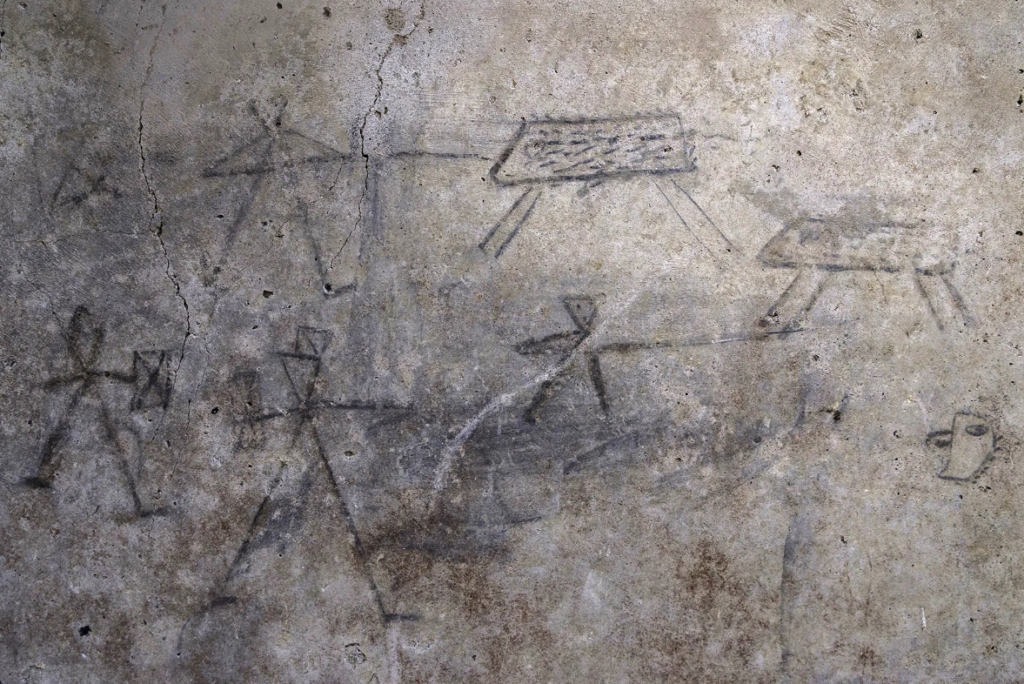
Recent discoveries at the archaeological park of Pompeii have unveiled a surprising aspect of ancient life: children’s sketches depicting scenes of violence involving gladiators and hunters battling animals. Gabriel Zuchtriegel, the park’s superintendent, revealed that these drawings, likely created by children aged five to seven before the eruption of Mt. Vesuvius in 79 AD, were found adorning the walls of a back room in the “Island of chaste lovers” residential sector of the park.
These drawings shed light on the reality that even children in ancient times were exposed to extreme forms of violence. Zuchtriegel emphasized that this exposure to violence was not solely a contemporary issue, noting the contrast between ancient times, where the violence witnessed in arenas was real, and the present, where it often manifests through virtual mediums like video games and social media.
Visitors to the park can now view these intriguing artifacts from suspended walkways while archaeologists continue their excavation efforts. The drawings depict various scenes, including gladiators engaged in combat with wild boars, as well as boxing matches. Additionally, an older painting on an adjacent wall, presumed to be made by an older child, portrays a sophisticated marine scene with ships and fantastical fish.
The park has initiated a collaboration with the Department of Child Neuropsychiatry at Naples’ Federico II University to delve into the significance of these children’s artworks. Initial findings suggest that the drawings likely originated from direct observation of violent events rather than from pictorial models.
Zuchtriegel emphasized the profound impact of witnessing such violence on the imagination of young Pompeian children, speculating that some may have attended fights in the amphitheater, exposing them to a spectacle of extreme violence that included executions of criminals and slaves.
In addition to these drawings, archaeologists discovered petrified remains of a man and a woman, presumed to be a couple, as well as a poignant painting of a small child wearing a hood surrounded by symbolic elements. These ongoing excavations represent part of a comprehensive effort to preserve Pompeii’s ancient legacy following years of neglect, uncovering glimpses into the daily lives and experiences of its inhabitants, both young and old.